

Rebuilding the Lighthouse of Alexandria, Block by Virtual Block
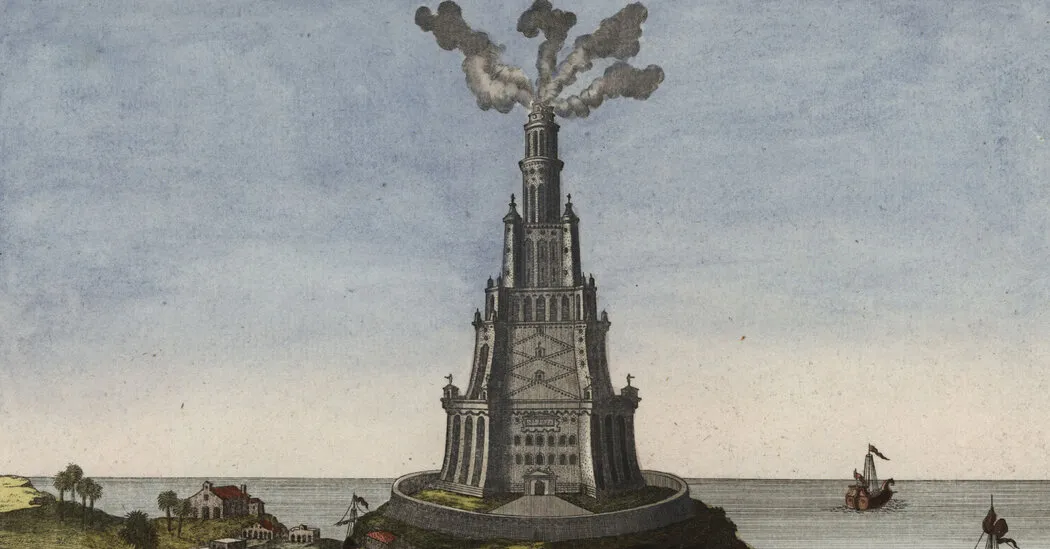
Towering over Alexandria, the vibrant Mediterranean port and capital of Ptolemaic Egypt, an enormous lighthouse was a symbol of the ambition of the Hellenistic age, a 460-foot skyscraper of granite and limestone that Gregory of Tours, a sixth-century A.D. Gallic bishop, deemed the seventh wonder of the ancient world. Its powerful beam was a nightly promise of safety for mariners approaching the treacherous coastline, and the structure was second in height only to the Great Pyramid of Giza, commonly accepted as the first wonder of the world and the only one that survives.
For nearly 1,600 years, the lighthouse, known as the Pharos of Alexandria, stood on an island at the entrance to the city’s eastern harbor as a sentinel defiant against time and nature, shrugging off dozens of earthquakes. But even monumental ingenuity has its limits; in A.D. 1303, a doozy of a tremor caused a tsunami so intense that it left the structure in shambles. Another quake, 20 years later, brought the rest crashing down, a tumble of statues and masonry eventually swallowed by the ever-rising sea.
“The architectural fragments lie scattered over 18 acres underwater,” said Isabelle Hairy, an archaeologist at the National Center for Scientific Research in France and the Center for Alexandrian Studies in Egypt. “The visibility is extremely bad, the seabed is uneven and there are no clear layers of sediment.”
For the last four years, Dr. Hairy has led the Pharos Project, guiding an elite squad of historians, numismatists, architects and graphics programmers to reconstruct the ancient lighthouse as a comprehensive digital twin. Having so far analyzed roughly 5,000 blocks and artifacts on the sea bottom, the team is reverse-engineering the ancient structure from its 14th-century collapse.
This ambitious fusion of antiquity and innovation relies on photogrammetry, which stitches together thousands of two-dimensional images to create precise three-dimensional models, effectively assembling a colossal archaeological puzzle piece by virtual piece.
“The project has enduring importance and interest globally, both for the underwater archaeology aspect and for the nature of the finds — including the 80-ton blocks,” said Paul Cartledge, a historian of Greek culture at the University of Cambridge who is not connected to the operation. “Try dredging those by hand. Not recommended.”
Thank you for your patience while we verify access. If you are in Reader mode please exit and log into your Times account, or subscribe for all of The Times.
Thank you for your patience while we verify access.
Already a subscriber? Log in.
Want all of The Times? Subscribe.