

Trump and Petro clash over how best to uproot Colombia’s cocaine crops
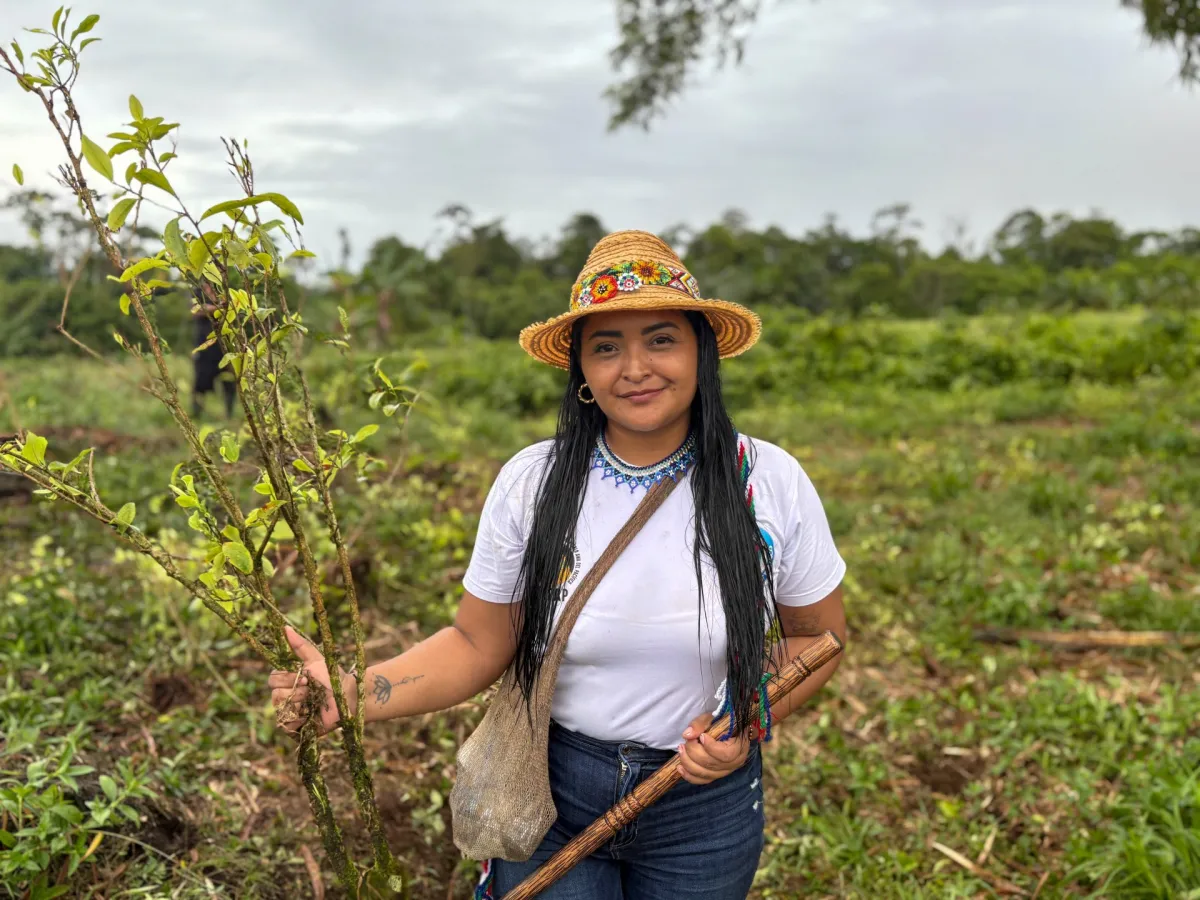
Tumaco, Colombia – A thin drizzle falls as farmer Yuli Caicedo crouches at the base of a short, spindly bush and grips its stem.
Wrenching it from the damp earth, she tosses it aside, just as dozens of others are doing. The field around them swiftly becomes a graveyard for uprooted coca plants.
Coca has long been one of the few ways to earn a living on the Awa Indigenous reserve in Colombia’s Narino department.
But the little green leaf, no wider than a golf ball, has fuelled a deadly trade. It is the raw ingredient for cocaine, and Colombia is the drug's largest source, producing nearly 70 percent of the world's supply.
How to curb coca production, however, has been an ongoing source of controversy.
For decades, Colombia had relied on aggressive military-led strategies and the forced eradication of coca crops. But Gustavo Petro, the country's first left-wing president, shifted tack.
He moved away from forced eradication — thought to disadvantage poor, rural farmers — and instead emphasised voluntary crop replacement, while continuing to clamp down on drug traffickers.
That strategy, however, has strained ties with one of Colombia's closest allies: the United States.
On Tuesday, Petro is set to meet with his US counterpart, Donald Trump, who has pressured him to pursue more aggressive tactics.
But Caicedo, a member of the Awa Indigenous community, is among those taking part in Petro's push for voluntary eradication.
She told Al Jazeera she knows firsthand the stakes involved in Tuesday's high-level strategy meeting: Her own father was assassinated by an armed group with ties to drug trafficking.
But she emphasised that farmers like those in her community have few economic opportunities outside of growing coca.
“At the end of the day, we were aware that what we were producing caused violence,” said Caicedo as she yanked up shrubs, a traditional wooden staff dangling from her neck.
“But there was no alternative.”
A shift in strategy
On his farm in the Awa reserve, resident Charles Martinez has already torn out his rows of coca plants and replaced them with legal harvests, such as plantain and cassava.
He is now helping others in the community remove the illegal crop.
“It feels different now doing it ourselves,” Martinez said of the government-backed removal effort.
“Before, it was always the army or the police, but forced eradication only made people angry, and they went back to coca because it was their livelihood.”
More than 16 million people live in poverty in Colombia, the equivalent of nearly a third of its population.
The country has also been enmeshed in a six-decade-long internal conflict with different factions — from right-wing paramilitaries to left-wing rebels — financing their efforts through drug trafficking.
A 2016 peace agreement proved to be a turning point. The country's largest rebel group, the Revolutionary Armed Forces of Colombia (FARC), agreed to disarm on the condition that the government would implement rural reforms.
Among the deal's terms was the creation of Colombia’s flagship coca substitution programme, PNIS. It offered cash assistance and support to small-scale coca farmers who voluntarily destroyed their crops.
Since taking office in 2022, Petro, a former rebel fighter, has embraced the programme. His administration has also touted its successes.
Luisa, a former coca grower in Colombia's Narino department, is among those enrolled in PNIS.
The government provides her with seedlings, plant cuttings and fertiliser to grow alternate crops like cacao and plantains, which she sells fried at a small stand.
“At first, it was hard planting the new crops, harder than growing coca,” she said. "Several times I fell, I got up, and here we are.”
All about the numbers
The Petro administration has also continued to target criminal networks that traffic in cocaine through arrests and the seizure of shipments.
In November, Petro announced the Colombian government had made its largest drug bust in a decade, with law enforcement nabbing nearly 14 tonnes of cocaine.
Gloria Miranda was appointed by Petro in 2024 to lead Colombia’s Directorate for the Substitution of Illicit Crops, the agency overseeing the voluntary eradication efforts.
She believes that the Petro administration's efforts have been mischaracterised as ineffective.
“There’s been a narrative that Colombia isn’t doing anything in the fight against drug trafficking,” she told Al Jazeera.
“But we’ve seized 276,000 kilogrammes [608,500 pounds] of cocaine, destroyed 18,000 laboratories, arrested 164,000 people, and are replacing more than 30,000 hectares [about 74,100 acres] of illicit crops.”
But critics — including Trump — argue Petro’s measures have yet to translate into results. Coca cultivation and cocaine production remain stubbornly at record levels.
According to the latest United Nations figures, coca cultivation rose in Colombia by about 10 percent in 2023. Potential cocaine output also jumped 53 percent to about 2,600 tonnes.

Petro has questioned the accuracy of those numbers, though. Last week, ahead of Petro's meeting with Trump, his government announced it would no longer use the United Nations figures, arguing that they rely on an “obscure statistical method".
Michael Weintraub, the director of the Center for the Study of Security and Drugs (CESED) at the University of the Andes, told Al Jazeera that some of Petro's pushback is political.
But he added that there is a genuine basis for questioning the UN's methodology.
“The ‘potential cocaine production’ measure has a lot of baked-in assumptions that make it very difficult to trust,” Weintraub said.
It predicts coca production from selected plots, but yields vary by region and season. The UN itself has admitted there are limitations in its method.
Despite these concerns, coca cultivation in Colombia has trended upward for decades.
Analysts note one overriding factor: demand. Consumption in North America and Europe remains strong, and new markets have emerged in Asia, Africa and South America.
“Coca can only grow in limited places due to climate, soil and elevation,” Weintraub said. “So Colombia is likely to remain a major producer for the foreseeable future.”
Is it about the drugs?
But the Trump administration has placed pressure on Colombia to stop the cocaine trade at its source.
Last September, Trump blamed Petro by name for failing to take "more aggressive action to eradicate coca and reduce cocaine production". The following month, he decertified Colombia as a partner in the US's fight against drug trafficking.
All the while, the right-wing Trump has made little secret of his hostility towards the left-wing Petro.
“Colombia is very sick, run by a sick man who likes making cocaine and selling it to the United States,” Trump said last month on board Air Force One.
After launching a military operation to abduct the leader of neighbouring Venezuela, Trump has repeatedly warned Petro to "watch his a**".
The US has wider strategic interests in the region, and Petro has not always aligned with Trump's priorities.
He has previously threatened to reject US deportation flights and criticised US actions against Venezuela, all while building closer ties with the country's main economic rival, China.
But there are signs of warming relations between the two leaders. On January 7, the two presidents held their first telephone call together. And Tuesday will mark their first face-to-face meeting in Washington, DC.
Weintraub believes Tuesday's meeting is more a question of political manoeuvring than lasting policy.
“I think it’s probably less important what Colombia actually does than what Trump can say he’s forced Petro to do,” Weintraub said. “Both sides will want to claim victory.”
He also questioned the aggressive tactics the US has employed to combat narcotics trafficking, including a series of 36 deadly attacks on alleged drug-smuggling boats in the Caribbean Sea and eastern Pacific Ocean.
Weintraub said the boat-bombing campaign is largely symbolic, since most cocaine enters the US hidden in commercial shipping containers.
“If they were serious about stopping cocaine, they would focus on customs and border enforcement through America’s ports,” he said. “Blowing up go-fast boats barely makes a dent.”
'Not a golden ticket'
Still, even in Petro's native Colombia, his anti-drug policies have faced pushback.
The country is facing new presidential elections in May, and Colombia's right wing is hoping to reclaim the Casa de Narino, the presidential palace, by portraying the left as soft on crime.
And while Petro has made gains in reducing poverty, critics argue he has not gone far enough to address the inequality that pushes farmers to coca crops.
“We need housing programmes, sanitation facilities. Our communities need many things we don’t have,” said Arsenio Valdes Cortes, a PNIS participant and community leader. “We want a long-term development plan, not a short-term one.”
Others point to failures in Petro's "Total Peace" platform, which sought to resolve conflict with armed groups through negotiation.
“The way security policy was focused under Total Peace meant less pressure on the strongest actors,” Weintraub said. “That helps explain why we’ve seen increases in crops.”
He added that coca substitution alone is not enough to eliminate cocaine production.
“It’s not a golden ticket,” Weintraub said. “Substitution won’t be as successful as it could be without a stronger security policy.”
Still, back on the Awa reserve, there is a sense of quiet relief as coca plants are uprooted. Caicedo said she was optimistic.
“We’re aware that if we work the land in a different way, the first thing that will happen is that we’ll begin to heal.”